 Lê Chí Đại
VoiceReaderAI
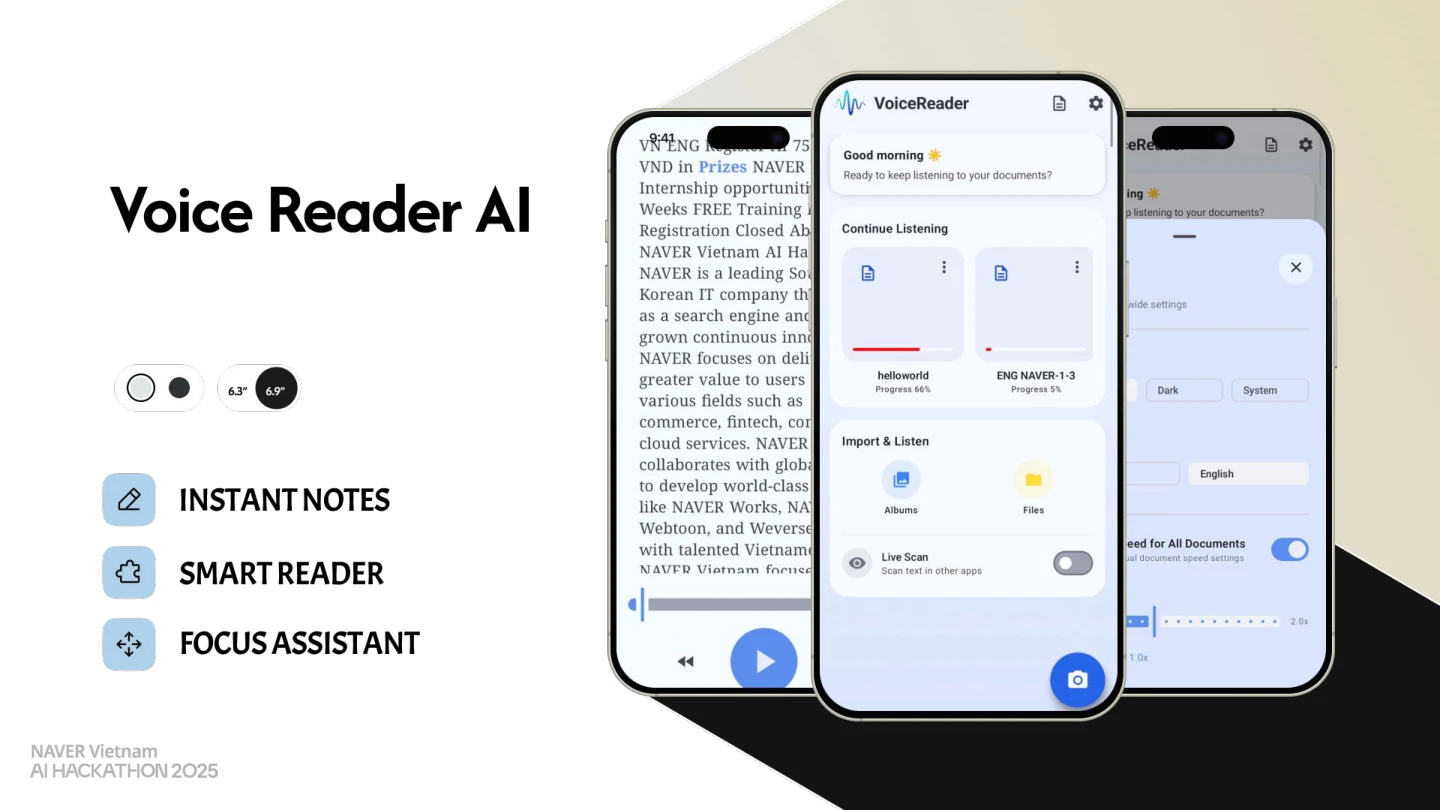
I led the technical architecture, core AI/backend implementation, and end-to-end integration of VoiceReaderAI, a national-finalist project at the NAVER Vietnam AI Hackathon 2025. Our four-person team, NaverUT, built an Android reading-assistance prototype connecting captured content to speech, summaries, notes, and contextual questions.
Project visuals
Figures from project reports, pitch decks, and saved experiment outputs. Select an image to open it at full resolution.
The problem
Reading long documents can be difficult for people who lose focus or experience reading difficulties. We designed VoiceReaderAI around an audio-first workflow for ADHD and dyslexic readers: bring reading assistance into the current screen rather than require repeated copying and app switching.
My core contributions
I owned the central technical workflow and coordinated the integration work that connected the application to the AI services.
- System architecture — designed the flow from captured or imported content through text extraction, retrieval, language-model responses, and audio output.
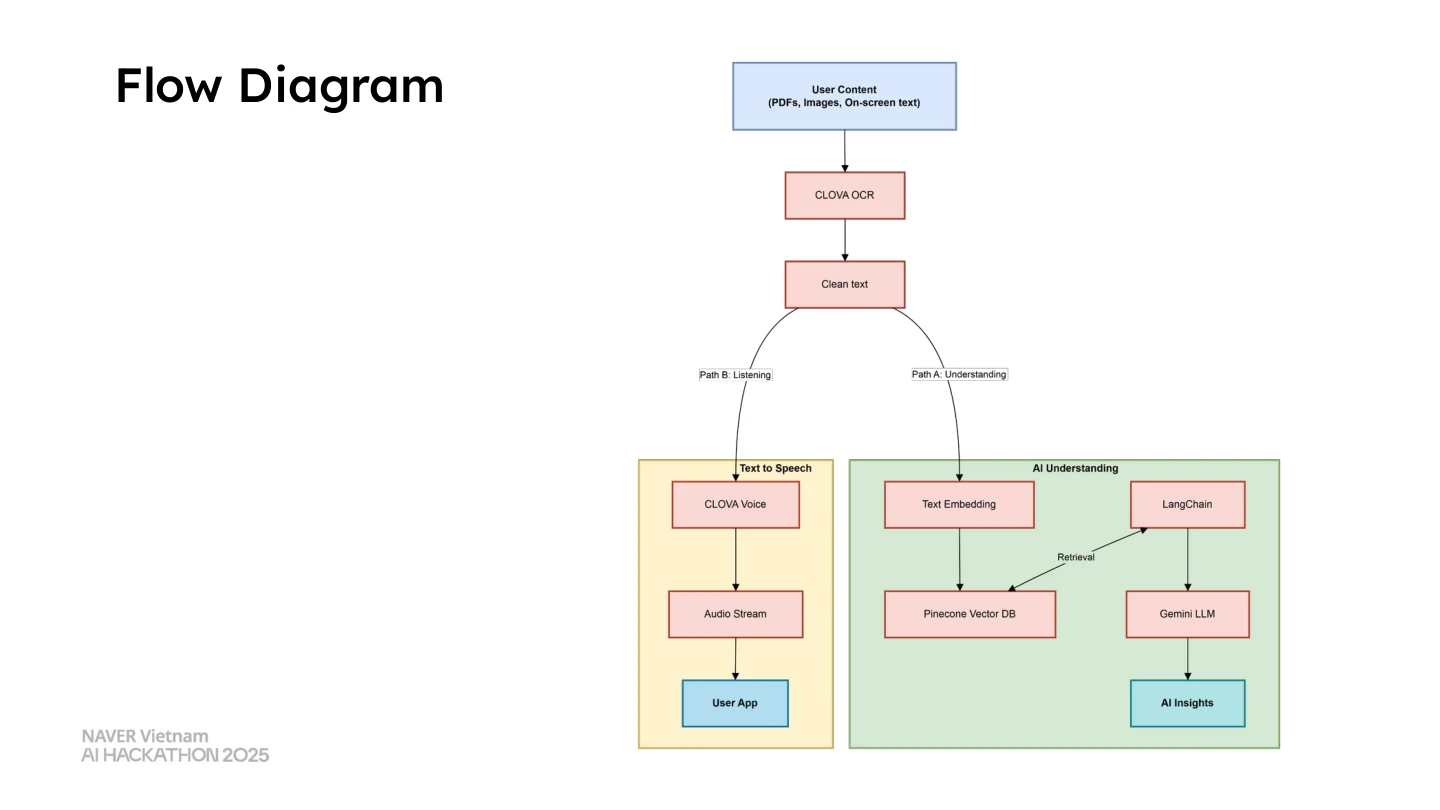
- Photo-to-answer pipeline — CLOVA OCR extracts text from a photo or screen, Pinecone retrieves the relevant passages, and Gemini answers questions over the document.
- Vietnamese narration — CLOVA Voice, plus voice cloning with VieNeu-TTS.
- AI understanding — implemented the core RAG workflow using Pinecone for vector storage, LangChain for retrieval orchestration, and Gemini for summaries and contextual Q&A.
- Backend and application integration — built the core Express.js service workflow and coordinated its integration with the Android application.
- Technical coordination — brought the application, backend, and AI services together into the end-to-end hackathon prototype.
Architecture: one input, two paths
The Android interface supports on-screen reading and imports such as PDFs, images, screenshots, and text files. Extracted text feeds two connected paths: narration through CLOVA Voice, and understanding through embeddings, Pinecone retrieval, LangChain, and Gemini. The deck identifies Express.js on NAVER Cloud as the backend and Android Jetpack as the application stack.
Engineering decisions
The project combined managed AI services with application and backend engineering. The core challenge was connecting those services into a coherent reading workflow.
- A floating overlay keeps reading assistance close to the content, reducing the need to switch applications.
- Separate listening and understanding paths support narration as well as follow-up summaries and questions over the extracted content.
- Retrieval provides content context for answers; it still requires evaluation for unsupported responses and OCR errors.
Outcome and scope
National finalist, NAVER Vietnam AI Hackathon 2025. The pitch deck documents the architecture, service stack, and Android interface preview. This was a hackathon prototype; public beta, broader platform support, and deeper AI understanding were follow-up plans.
The next evaluation step is to measure OCR quality, answer grounding, and capture-to-audio latency, then test the reading workflow with users.
Project artifacts
The original team source repository is no longer publicly accessible. The pitch deck and landing page preserve the project context and architecture. The case study describes the hackathon prototype; the landing page also includes proposed product and business plans.